
By the summer of 2026, the luxury interior design space has underwent a quiet but profound rebellion against the sterile, monochromatic wood matching of the past decade. For years, the industry operated under a rigid, almost corporate rulebook: if a room had a white oak floor, its shelves, tables, and chair legs had to match in identical, bleached-out harmony. While this matched wood approach offered a sense of clean minimalism, it often felt cold, flat, and hollow. Today, we are witnessing the rise of Warm Timber & Tactile Contrast—a movement that celebrates mixed wood tones, raw red cedar, and weathered grains to introduce layered, geological depth and cozy luxury to modern sanctuaries.
This biological shift is a tactical embrace of natural complexity. As we have explored in our previous brand studies on the earthy richness of Terra-Cotta Healing, the horizontal sedimentation of Geological Stratum, and the fluid silhouettes of Modern Zen, human beings thrive when surrounded by textures that carry natural variations and the physical imprint of deep, geological time. Today, we turn our attention to the forest's oldest crop—and how mixing wood grains can heal our over-stimulated nervous systems.
Section 1: The Psychology of Mixed Wood—Reclaiming Natural Imperfection
In evolutionary biology, our visual systems are highly tuned to process the irregular, dynamic patterns of the forest. When we walk through a natural forest, our eyes do not see a single, uniform wood species. We see the deep, charcoal-dark trunks of weathered pines, the warm red core of red cedar, and the pale, sandy-gold bark of silver birches. This natural variation—this "mixed wood tone" landscape—is what our minds associated with safety, life, and abundance.
In 2026, home design is utilizing this psychological baseline to reduce ambient stress. Homeowners are actively rejecting the flat, laminated, and artificially uniform wood finishes of mass production in favor of materials that retain their natural variations. Knots, sapwood lines, dynamic grain directions, and mixed wood species are celebrated as visual "rhythm markers." By layering light, medium, and dark wood tones within a single room, we create a rich, organic visual depth that feels warm, authentic, and deeply grounding.
Section 2: The Timber Dialogue—Contrasting Grains and Densities
The true art of Warm Timber lies in the curation of contrasts—the hallmark of the modern **Curated Gallery** home. At Borealforest, our design philosophy is deeply rooted in this material dialogue. We believe that a space becomes alive when materials are allowed to talk to one another through their physical differences.
To design with mixed wood tones is to create a multi-layered acoustic and visual harmony:
- The Light Anchor (White Oak): Light, low-saturation white oak slatted wall panels serve as a clean, expansive, and architectural background. The pale wood reflects ambient daylight, keeping the space feeling airy, open, and minimalist.
- The Medium Heart (Red Cedar): Raw, unpolished red cedar introducing warmth, a rich reddish-brown core, and a highly satisfying, aromatic fragrance (*cedar-wood oil*) that acts as an instant olfactory decompressor for the limbic system.
- The Dark Anchor (Dark Walnut): Rich, dark-grained black walnut pedestal blocks and tables provide structural weight. These dark accents anchor the room, drawing the eye downward and giving the space a sense of permanent, geological gravity.
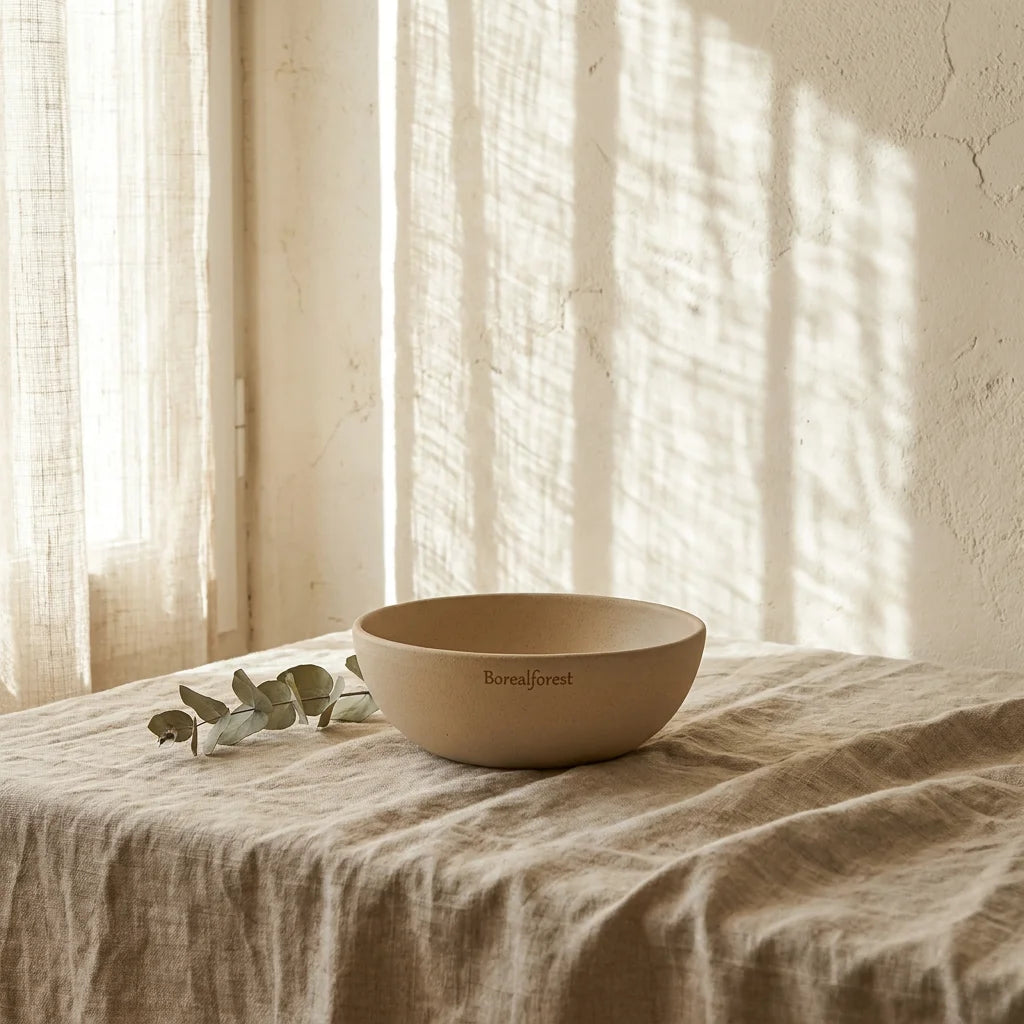
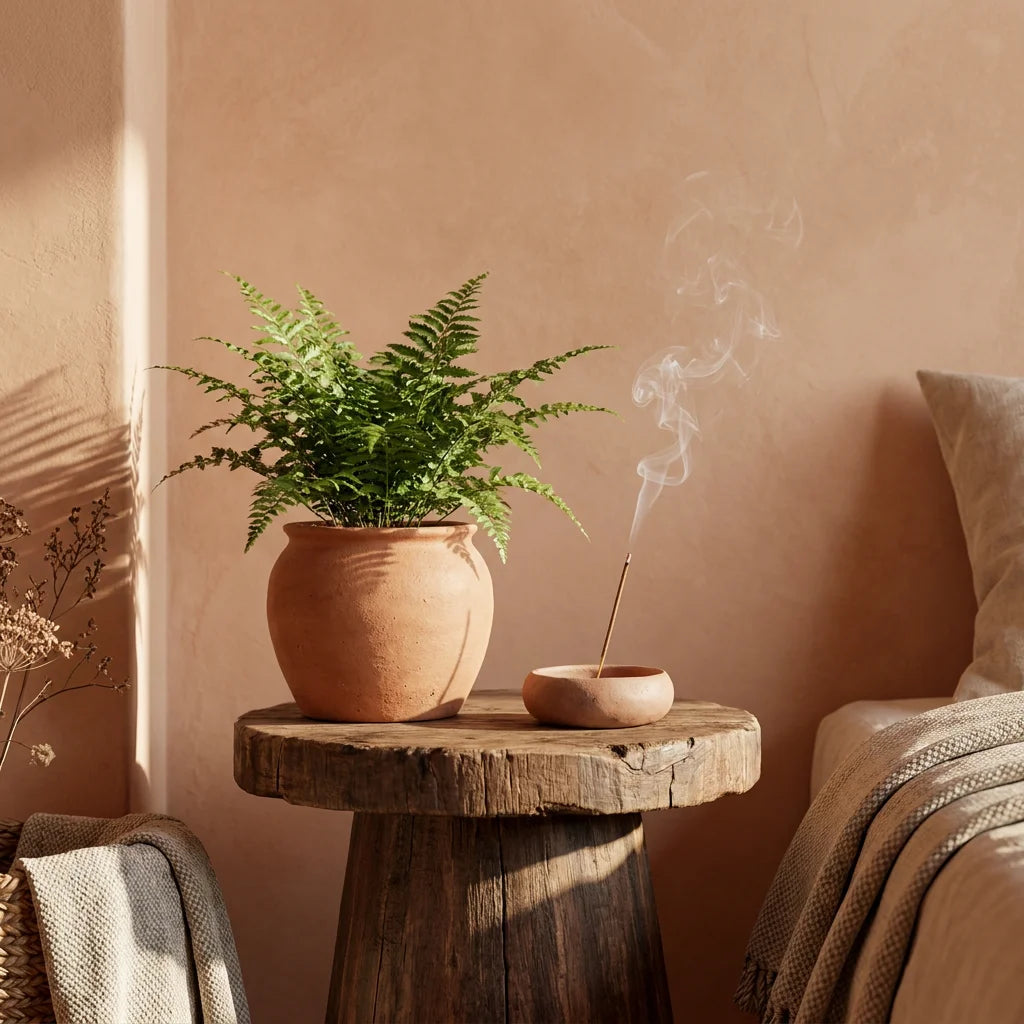
When you place an unglazed, sand-tempered Borealforest ceramic vessel on a low black walnut pedestal against a light white oak wall, you are witnessing a powerful material dialogue. The coarse clay, the dark velvety wood, and the pale slats work in harmony to soothe your senses, as explored in Solfatara Textures and the light-sculpting properties of Sensorial Light.
Section 3: Tactile Friction and Somatic Calming
In high-tech interior environments, our sense of touch is often starved. We touch the smooth, glass-like surfaces of our devices, swipe across friction-free plastic keys, and eat from perfectly uniform glazed ceramic or glass plates. This frictionless existence has left our skin's mechanoreceptors dormant, leading to what neuroscientists call "tactile fatigue."
Our hands crave friction, resistance, and temperature variations. Solid, rough-grained woods like red cedar and oak are highly responsive thermal and tactile interfaces:
- Thermal Responsiveness: Solid wood has a high natural thermal capacity and low conductivity. Unlike cold metal or glass, it absorbs and retains the ambient warmth of the room and your hands. Touching a raw cedar wood desk feels warm, establishing a somatic feedback loop that signals safety to your limbic system.
- Frictional Grounding: Running your palm along the raw, unpolished live edge of a cedar table provides a rich, irregular tactile feedback. The slight rise of the grain, the micro-porosity of the fiber, and the grit of the wood provide "speed bumps" for your hands, anchoring your awareness fully in the present moment of your ritual.
This physical grounding is what we define as **Material Therapy**, the foundation of our hand-built creations, as detailed in our study on The New Artisanal Renaissance and The Living Stone.
Section 4: The Neuro-Aesthetics of "Komorebi" Light and Wood
The sensory impact of mixed timber is amplified when it interacts with natural light. One of the most celebrated concepts in 2026 neuro-aesthetics is **Komorebi**—the Japanese term for natural sunlight filtering through the leaves of trees, casting dynamic, dappled shadows.
When this soft, moving light falls across a raw red cedar table, it creates several positive biological responses:
- Dopamine Release: The irregular, organic play of dappled shadows across natural wood grains is highly pleasing to our visual cortex. Studies show that processing fractal geometries (found in both wood grain and tree leaf shadows) requires less neural effort, allowing the brain to enter a relaxed, meditative "open monitoring" state that reduces anxiety and sparks creativity.
- Cortisol Suppression: The grounding aroma of red cedar—specifically *cedrol*, which is naturally released by unpolished timber—has been clinically proven to lower heart rate and sympathetic nervous system activity, reducing cortisol levels and somatic tension.
- Tactile-Optical Integration: As we look at the warm, rich grain of cedar illuminated by Komorebi light, our brains perform a cross-sensory translation. We "feel" the warmth and texture of the wood simply by looking at it, anchoring us fully in our physical reality.
Section 5: Curating Your Warm Timber Sanctuary
Integrating mixed wood tones into your modern Zen home is about creating a curated collection of tactile and visual contrasts:
1. The Contrast of Smooth and Rough: Place a heavily textured Borealforest sediment-glazed vessel on a smooth, lightly brushed oak or ash console table. The sleek, clean lines of the oak highlight the rugged, ancient qualities of the ceramic, creating a beautiful organic tension that feels museum-like and highly intentional.
2. Layering Organic Materials: Pair different wood species and tones with other natural elements. Place an unglazed raw clay cup and an unpolished soapstone tray on a solid cedar coffee table. Complete the setting with heavy, un-ironed Belgian linen napkins to add cozy, tactile depth to the space, as explored in Silent Sanctuaries.
3. The Low-Angle Light Play: Place your mixed wood elements where they can interact with natural morning or afternoon side light. As the sun moves, the changing angles of light will cast long, elegant shadows across the grains of oak, cedar, and walnut, transforming your room into a living, slow-moving sundial of mindfulness.
Conclusion: Invest in the Slower Way of Living
In 2026, choosing raw, unpolished, mixed timber and hand-signed ceramics over mass-produced plastics and chrome is a radical act of self-care. It is a decision to prioritize material truth, human artistry, and biological wellness in our daily lives.
We invite you to explore the Studio Archive of Borealforest today, find your perfect warm timber anchor, and bring the forest's quiet, cozy luxury home.